Table of Contents
- What Defines Reliable Local Commercial Locksmith Services?
- Commercial Locksmith Services: A Price Guide for Businesses
- The Critical Role of Licensed Locksmith Verification
- Modernising Your Premises with Commercial Electronic Access Control
- Master Key Systems and Integrated Security Solutions
- Preventative Maintenance and Security Audits
- Why Morayfield Locksmiths is the Reliable Choice
- Conclusion
- Frequently Asked Questions
Last Updated: September 7, 2026
What Defines Reliable Local Commercial Locksmith Services?
A reliable local commercial locksmith service is a licensed, insured provider that offers rapid response, transparent pricing, and comprehensive security solutions tailored to business premises. The distinction matters because the cost of getting this wrong is steep. Industry analysis suggests a single missed emergency call costs service providers over $185, and with AgentZap’s 2026 analysis of locksmith phone statistics, roughly 67% of all locksmith calls arrive after standard business hours. For a business locked out at 7 pm on a Friday, that statistic is the difference between a minor inconvenience and a lost night of trading.
The businesses that fare best build a relationship with a provider before an emergency strikes. A genuine emergency lockout service operates around the clock and backs its work with licensed, insured technicians rather than subcontracted crews.
Commercial Locksmith Services: A Price Guide for Businesses
Commercial locksmith pricing does not follow a simple rate card, and any provider quoting a flat fee for every job is probably hiding something. The cost depends on the hardware specified, the complexity of installation, and whether the work is scheduled or urgent.
What most guides miss is that the true price difference sits in the hardware tier. A basic deadbolt replacement costs a fraction of a restricted key system or an integrated electronic access control setup. The LinkedIn Pulse forecast on the emergency locksmith service market projects 14.5% compound annual growth through 2033, driven largely by businesses moving away from traditional keys toward electronic systems. That shift changes the pricing conversation entirely: you are no longer paying for a locksmith visit, you are paying for an ongoing security infrastructure.
Building a Business Case: The ROI of Security Hardware
For property managers and business owners, the decision is about the cost of a security failure over time. A standard deadbolt versus a high-security cylinder differs by roughly $80 to $150 per door, but a standard cylinder can be picked or bumped in under two minutes with tools available online for under $50. A high-security cylinder with restricted key blanks resists these attacks and prevents unauthorised duplication. If a break-in costs your business an average of $5,000 in lost stock, damaged premises, and insurance excess, the premium pays for itself many times over.
A similar logic applies to electronic access control. A basic standalone keypad lock costs around $300 to $600 per door, installed; a networked system with audit trails and remote management runs $1,500 to $3,000 per door. When an employee leaves, rekeying a mechanical lock costs $150 to $250 per lock and requires a technician visit, whereas deactivating a fob or PIN in an electronic system takes 30 seconds and costs nothing.
Beware of locksmiths who quote one price over the phone and charge double on arrival. Honest upfront pricing means the quote you receive is the invoice you pay, with no surprise call-out fees or “parts” markups. Always request a written itemised quote before work begins.
The Hidden Cost of Downtime
The most expensive line item in any commercial lock failure is operational downtime. A failed lock on a retail storefront at 8:30 am means staff cannot open, customers cannot enter, and revenue stops. For a business turning over $1,000 per hour, a two-hour delay waiting for an emergency locksmith costs more than the entire annual maintenance contract for that door.
Scheduled preventative maintenance is an insurance policy against unpredictable downtime. A quarterly inspection of all commercial doors, locks, and panic hardware typically costs $150 to $300 per visit for a small premises, compared to a single after-hours emergency call-out, which often exceeds $350 before any parts are fitted.
Budgeting for Security: A Practical Framework
When planning your security budget, work through this framework:
- Audit your current hardware. List every external door, internal restricted area, and access point. Note the age and condition of each lock.
- Assess your risk profile. A ground-floor retail premises in a high-traffic area faces different risks than a second-floor office. Your insurance policy may also specify minimum security requirements.
- Prioritise by vulnerability. External entry points and areas containing high-value assets or sensitive data come first.
- Compare lifecycle costs. A cheap lock that fails in two years costs more than a quality lock that lasts ten, once you factor in repeated call-out fees and downtime.
- Phase the rollout. You do not need to upgrade every door at once. Stagger the work across financial quarters to spread the cost.
The cheapest quote is rarely the most cost-effective solution. When evaluating commercial locksmith pricing, calculate the total cost of ownership over five years, including maintenance, potential downtime, and the cost of a security breach. That number, not the initial invoice, is what matters for your business.
For businesses weighing reliable local commercial locksmith services, the decision comes down to accountability. Morayfield Locksmiths has served the Moreton Bay region as a family-owned operation since 1994, combining 24-hour availability with rapid response times and honest, upfront pricing. The range of services covers commercial-grade access control, CCTV installation, and restricted keying for multi-building property portfolios.
What sets us apart is the willingness to integrate old and new systems rather than forcing a full replacement. Customers consistently note the speed of arrival and the professionalism of the technicians, whether handling a scheduled security upgrade or an emergency lockout. For commercial properties where downtime means lost revenue, that reliability is the entire point.
The Critical Role of Licensed Locksmith Verification
Verifying a locksmith’s credentials is your primary defence against both poor workmanship and security risks. A licensed locksmith has met state-based training and police-check requirements, which matters when you are handing over access to your entire premises.
The challenge is that the market is crowded with lead-generation services masquerading as local experts. Property managers across the region have told us they struggle to distinguish between genuine technicians and marketing operations that lack verified technical credentials, a concern echoed in community discussions on identifying legitimate locksmith expertise. The verification process is straightforward: ask for their licence number, confirm their insurance covers commercial work, and check that the technician arriving is the same qualified person you booked.
Modernising Your Premises with Commercial Electronic Access Control
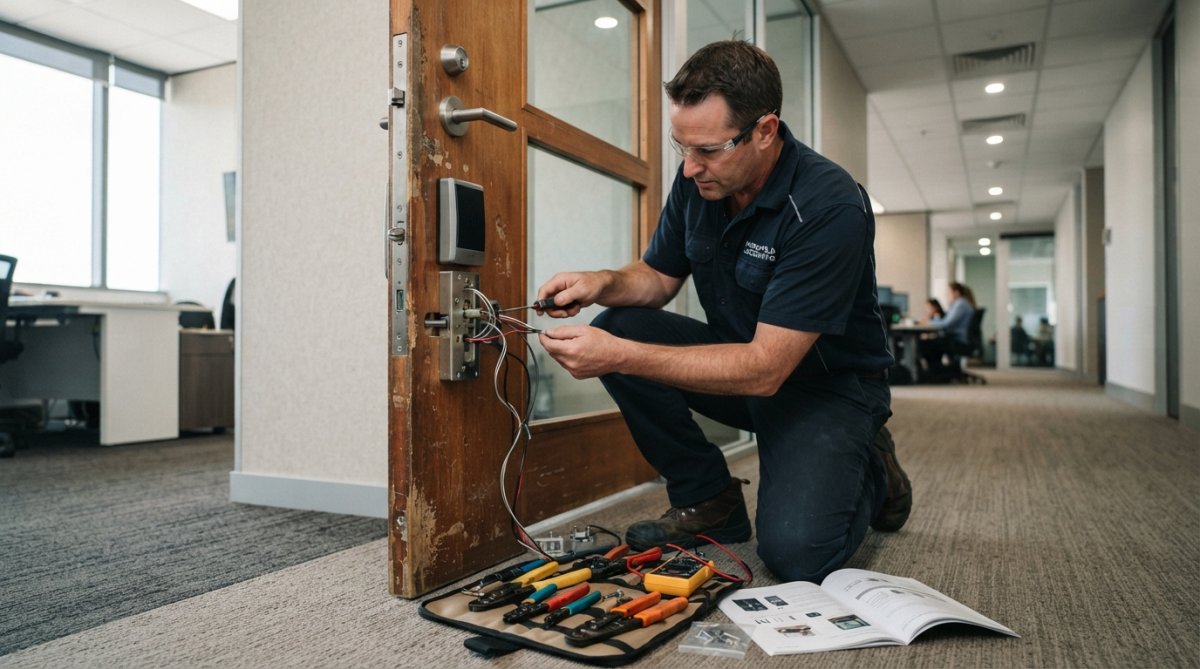
Commercial electronic access control replaces the guesswork of physical key management with granular, auditable entry permissions. Instead of rekeying locks when an employee leaves, you simply deactivate their fob or PIN code, a process that takes seconds rather than hours.
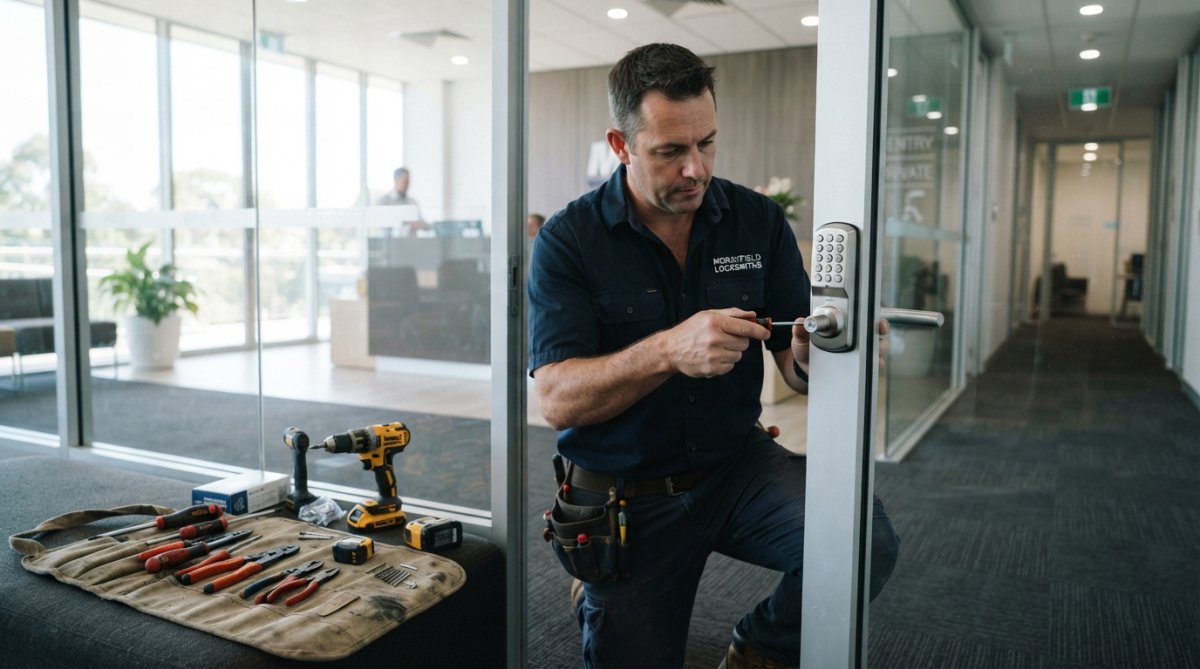
The integration challenge is real: many properties run a mix of old mechanical locks and newer smart hardware, and the systems often fail to communicate. A qualified technician will assess your existing door hardware and design a migration path, rather than ripping out functioning locks to force a uniform system. The Map Kings 2026 guide on local SEO for locksmiths notes that providers increasingly rank on their ability to integrate these layered security solutions, which reflects what property owners actually need: one coherent system, not a patchwork of incompatible devices.
When evaluating electronic access control, ask about offline credentials. If your network goes down, you still need doors to unlock for authorised staff. Battery-powered, offline-capable locks avoid single points of failure.
Master Key Systems and Integrated Security Solutions
A master key system is the backbone of efficient commercial security, allowing one key to open multiple doors while restricting staff access to specific zones. For property managers overseeing several buildings, this eliminates carrying dozens of keys while maintaining clear audit trails of who can access what.
Restricted key systems take this further: the key blanks are patented, so only authorised locksmiths can cut duplicates, preventing the classic failure where an ex-employee’s key still works because they copied it before leaving. Integrated security solutions combine these mechanical systems with electronic access control, CCTV, and alarm monitoring, creating a layered defence where a failure in one system is caught by another.
Compliance, Insurance, and Your Legal Obligations
Under Australian law, business owners have a duty of care to provide a safe workplace, extending to controlling access to premises. If an unauthorised person gains entry because of a faulty lock or an outdated master key system, the business owner can be held liable under workplace health and safety legislation.
Many business insurance policies include specific clauses requiring adequate locking mechanisms on external doors and restricted areas. If a claim is lodged after a break-in and the insurer determines the locks did not meet the policy’s minimum standards, the claim can be reduced or denied entirely. A professional locksmith helps you meet these standards by installing hardware that complies with Australian Standard AS 4145.2 for locksets and AS 1906 for door hardware.
Failing to maintain adequate security can void your insurance coverage. If your policy requires specific locking mechanisms and you have not upgraded or maintained them, an insurer may refuse to pay out after a theft. Always request a written security assessment from your locksmith and keep it on file.
Fire Exit Compliance and Life Safety
Master key systems and integrated security solutions must also account for fire exit requirements. Australian Standard AS 1428.4 and the National Construction Code mandate that fire exits must open easily from the inside without a key, creating a tension with security: you want to restrict entry, but you cannot restrict exit in an emergency.
A professional locksmith resolves this with panic hardware and emergency exit devices that allow free egress while maintaining secure entry. Push bars, panic latches, and electromagnetic locks with fail-safe release mechanisms meet these dual requirements. This is a specialised area where general handymen and unlicensed operators often fail, creating a serious life-safety risk.
Documenting Your Security for Audits and Liability
Beyond the hardware itself, a professional locksmith provides documentation that protects you legally. This includes:
- A key register listing all keys issued, to whom, and when
- A maintenance log showing regular inspections and repairs
- Certificates of installation for compliant hardware
- A door schedule mapping access levels across your premises
This documentation demonstrates due diligence if a security breach occurs, supports insurance claims, and provides evidence of compliance during workplace health and safety audits. Property managers who cannot produce these records are exposed to significant liability.
Integrating Smart Locks with Existing Office Systems
Modern commercial spaces are moving toward IoT-enabled access control.
Smart locks for offices can integrate with existing building management systems, HR platforms, and visitor management software. When an employee leaves, their digital credentials are revoked automatically; when a contractor needs temporary access, you can issue a time-limited code from your phone. These systems also generate audit logs showing exactly who entered which door and when.
The Map Kings 2026 guide on local SEO for locksmiths notes that providers increasingly rank on their ability to integrate these layered security solutions, which reflects what property owners actually need: one coherent system, not a patchwork of incompatible devices.
When evaluating electronic access control, ask about offline credentials. If your network goes down, you still need doors to unlock for authorised staff. Battery-powered, offline-capable locks avoid single points of failure. Also ask whether the system integrates with your existing HR or building management software before committing to a proprietary platform.
A master key system is not just about convenience; it is a legal and insurance safeguard. Work with a locksmith who documents everything, complies with Australian standards, and designs for both security and life safety. That documentation is your protection if something goes wrong.
Preventative Maintenance and Security Audits
Commercial security is not a set-and-forget investment. Locks wear, door closers drift out of alignment, and panic bars seize up, often failing exactly when you need them most. A preventative maintenance schedule, typically reviewed quarterly, catches these issues before they become emergency call-outs.
A professional security audit examines more than just the locks: it assesses door frames, hinge strength, glazing, and whether your current hardware meets the risk profile of your premises. The audit should also review compliance with Australian standards for commercial door hardware, including fire exit requirements and accessibility. QuoteIQ’s 2026 review of locksmith business software highlights how digital transformation is reshaping service delivery, with providers using specialised systems to track maintenance schedules and dispatch history, ensuring no lock is forgotten until it breaks.
A scheduled maintenance visit costs a fraction of an emergency call-out, and it prevents the operational downtime that comes with a failed lock at opening time. If your provider does not offer scheduled audits, find one that does.
Why Morayfield Locksmiths is the Reliable Choice
For businesses weighing reliable local commercial locksmith services, the decision comes down to accountability. Morayfield Locksmiths has served the Moreton Bay region as a family-owned operation since 1994, combining 24-hour availability with rapid response times and honest, upfront pricing. The range of services covers commercial-grade access control, CCTV installation, and restricted keying for multi-building property portfolios.
What sets us apart is the willingness to integrate old and new systems rather than forcing a full replacement. Customers consistently note the speed of arrival and the professionalism of the technicians, whether handling a scheduled security upgrade or an emergency lockout. For commercial properties where downtime means lost revenue, that reliability is the entire point.
Conclusion
The market for commercial locksmith services is growing quickly, but growth attracts operators who prioritise lead volume over technical skill. Protect your premises by verifying licences, demanding transparent pricing, and investing in preventative maintenance rather than waiting for failures. When you need a partner who understands both traditional hardware and modern electronic systems, Morayfield Locksmiths delivers fast, secure solutions backed by three decades of local experience.
Frequently Asked Questions
How much do commercial locksmiths charge on average in Australia?
Pricing for commercial locksmith services varies widely depending on the job’s complexity, the type of hardware, and after-hours callout requirements. A simple key duplication is far less costly than installing a complete commercial electronic access control system. For a transparent commercial locksmith services price guide, it’s best to request a detailed quote. A reliable local provider will offer honest, upfront pricing before any work begins, ensuring there are no surprises on your invoice.
How can I verify if a local locksmith is licensed and insured?
Performing licensed locksmith verification is a crucial step. Ask the company for their licence number and a certificate of insurance. A reputable business will readily provide these documents. You can also check with your state’s fair trading or licensing body to confirm their credentials are current. Hiring a licensed and insured locksmith protects your property and ensures the technician has the verified skills to handle commercial-grade security systems safely.
Are 24/7 commercial locksmith services more expensive?
Yes, emergency callouts outside standard business hours typically incur a higher fee, which is standard practice across the industry. With 67% of locksmith calls occurring after hours, this pricing structure allows providers to maintain a rapid response team. However, the cost of a missed emergency call, estimated at over $185, often outweighs the service fee. Always ask for the after-hours rate upfront to avoid unexpected charges.
What is the best door lock brand for commercial security in Australia?
The best brand depends on your specific security needs, from high-traffic door closers to restricted key systems. Instead of focusing on a single name, look for a locksmith that offers a range of commercial-grade options, including electronic locks and master key systems. A qualified technician can assess your premises and recommend the most suitable hardware from reputable manufacturers to meet your security and budget requirements.