Table of Contents
- Why Garage Door Security Matters More Than Ever
- Start With the Right Garage Door Security Locks
- Reinforce the Door: Anti-Lift Brackets and Guide Tracks
- Emergency Release Cord Security: Stop the Coat Hanger Trick
- Smart Garage Door Opener Security: Rolling Codes and Encryption
- Lock Down the Side Door and Service Entry
- Maintenance, Insurance, and Visual Deterrents
- Frequently Asked Questions
Last Updated: September 21, 2026
Why Garage Door Security Matters More Than Ever
The global garage and overhead doors market reached USD 8.02 billion in 2026, according to Research and Markets’ garage and overhead doors market report. That growth brings more automated doors, more wireless remotes, and more ways for thieves to get in.
Start With the Right Garage Door Security Locks
The best garage door security locks are surface-mounted deadbolts and floor bolts installed on the inside of the door. These stop the door from being forced open, even if someone defeats the opener.
Surface-Mounted Locks and Floor Bolts
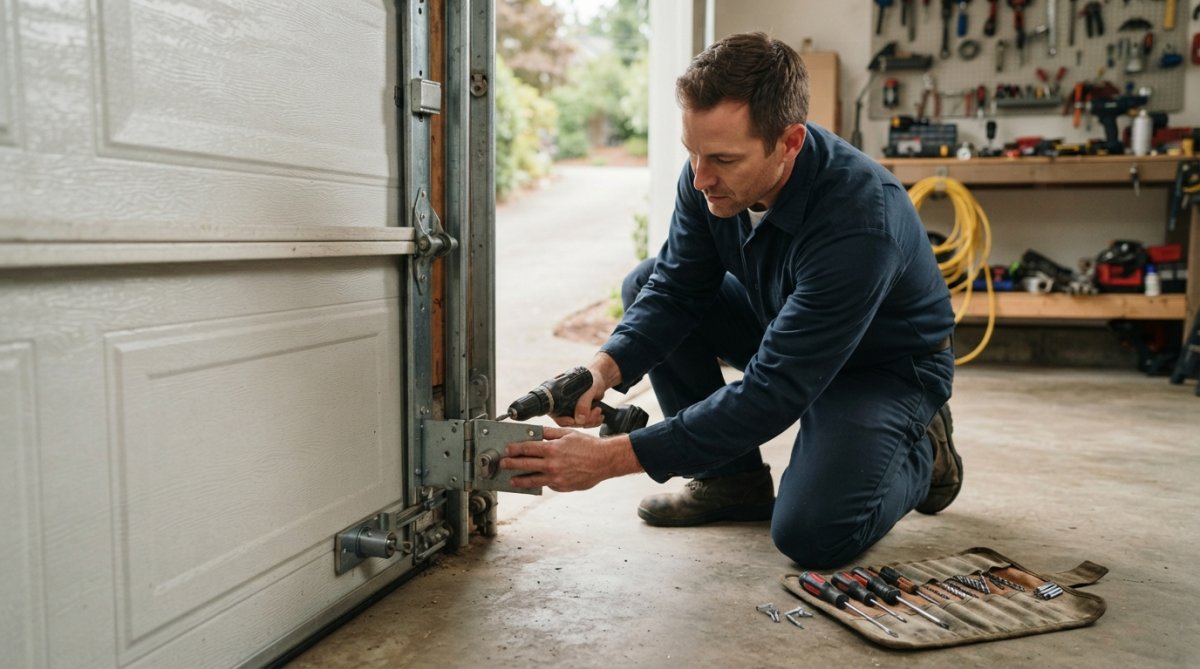
A surface-mounted lock bolts to the inside of your garage door and frame, physically blocking it from moving. A floor bolt goes further: it drives a steel rod into your concrete floor, so even with the rollers removed, the door won’t lift.
Here’s what to look for:
- Solid steel construction, not cast metal
- A bolt that extends at least 25mm into the floor or frame
- Tamper-proof screws so the lock can’t be unscrewed from outside
- A keyed cylinder that resists picking
Fit your floor bolt on the side of the door furthest from the opener motor. Thieves rarely check both sides, and the extra travel time works against them.
Reinforce the Door: Anti-Lift Brackets and Guide Tracks
An anti-lift bracket is a steel plate that stops someone prying the door up and off its tracks, one of the cheapest, most effective upgrades you can make. A thief can lever a door out of its vertical guide tracks and slide it up even with the opener locked; anti-lift brackets close that gap.
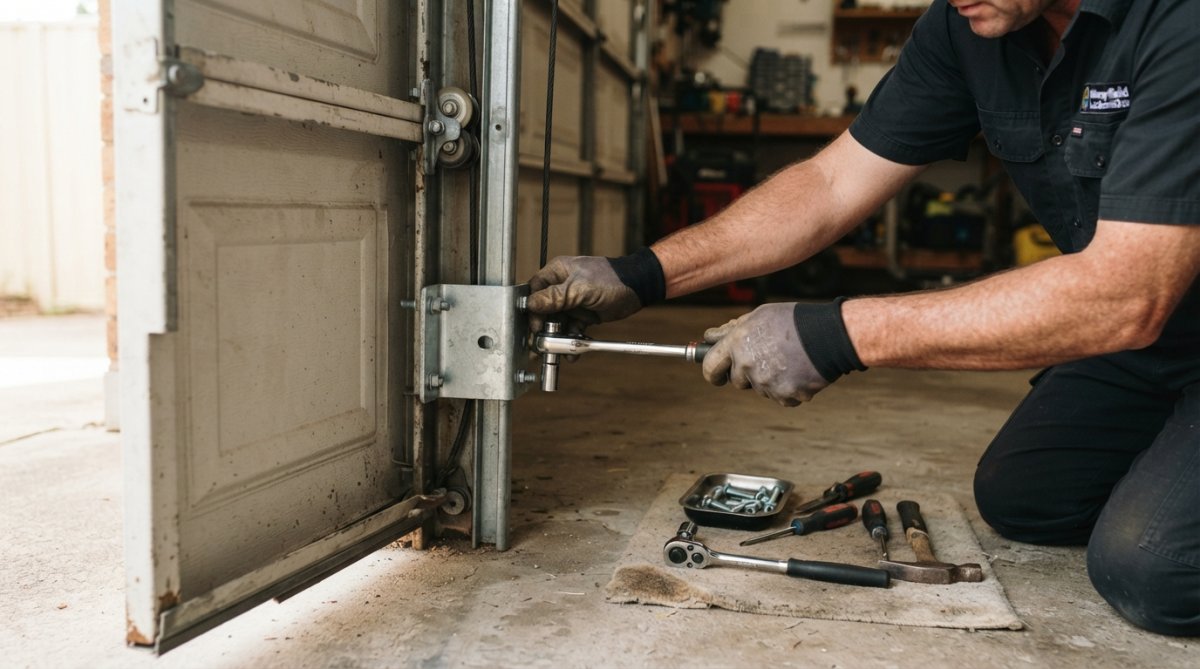
Securing the Bottom Rail and Strike Plate
The bottom rail is the lowest horizontal section of your door and takes the most force during a break-in, reinforce it with a steel plate or reinforced bottom bracket. Your strike plate is easy to defeat if short; swap it for a longer one with at least three screws going deep into the frame.
Quick checklist for this step:
- Install anti-lift brackets on both sides
- Check guide tracks for bends or loose bolts
- Add steel reinforcement to the bottom rail
- Replace short strike plates with long ones
- Use 75mm screws, not the short ones that come in the pack
Emergency Release Cord Security: Stop the Coat Hanger Trick
The emergency release cord is the rope you pull to open the door by hand during a power cut, and the easiest way into your garage. A thief pushes a wire coat hanger through the gap at the top of the door, hooks the cord, and pulls; the door disconnects and slides open in seconds. Fixing this takes ten minutes.
- Tie the cord up short so it sits above the hanger’s reach
- Zip-tie it to the trolley arm, leaving a small loop
- Fit a cord shield that covers the release mechanism
- Use a locking clip that only opens with a key
Smart Garage Door Opener Security: Rolling Codes and Encryption
A smart garage door opener is only as secure as its weakest signal. Most guides stop at “get rolling codes and you’re fine”, advice that’s a decade out of date. Modern openers are networked devices, and networked devices get attacked like networked devices.
How Attackers Defeat Older Openers
Three mechanisms account for most smart-opener compromises:
- Fixed-code capture and replay. Older remotes transmit the same code every press; a cheap receiver records it and the attacker replays it later.
- Code grabbing with a jammer. A stronger signal overwhelms your remote; the opener misses the legitimate code, but the attacker’s device captures it. You walk inside thinking the door is locked; the attacker opens it minutes later.
- Rolling code defeat via “rolljam” style attacks. Even rolling-code systems can be beaten if the attacker captures two consecutive codes and blocks one, which is why you need encryption on top.
What to Actually Look For
When you’re buying or upgrading, these are the specifications that matter:
- Rolling code technology as an absolute minimum: every press sends a new code the opener accepts only once.
- Encrypted signal transmission, an encrypted payload, not just a changing code. Look for encrypted wireless protocols rather than just “rolling code.”
- Two-way authentication between remote and opener, so a captured signal can’t be replayed.
- Firmware update capability. If the manufacturer doesn’t push security patches, the device ages badly.
- A manual override you physically control, not one hidden outside.
The Digital Side Most Guides Ignore
Your opener’s Wi-Fi connection is a second front door. If someone gets onto your home network, they can often reach the opener’s app or local API directly.
Harden it like this:
- Change the default password on the opener, the app, and your router. Default credentials are published online and scraped constantly.
- Turn on two-factor authentication in the opener’s app, the single highest-value step, and one almost no competitor guide mentions.
- Update firmware the moment a patch is released.
- Segment your network. Put smart openers, cameras, and other IoT devices on a separate Wi-Fi SSID or VLAN from your laptops and phones, so a compromised device can’t pivot to your personal data.
- Disable remote access if you don’t use it, fewer features, fewer attack surfaces.
- Audit app permissions. A garage app requesting contacts, location history, or microphone access is a red flag. Revoke anything unnecessary.
Never leave the manual override key hidden outside in a fake rock, under a mat, or in a meter box. That’s the first place a thief looks. Keep it on your keyring or with a trusted neighbour.
Australian Regulatory Context
The Security of Critical Infrastructure Act 2018 (SOCI Act) and its 2022 amendments place obligations on critical infrastructure operators, but the practical takeaway for homeowners is simpler: the Australian Cyber Security Centre (ACSC) publishes the Essential Eight mitigation strategies, and several, multi-factor authentication, patching applications, restricting administrative privileges, apply directly to configuring a smart opener. The ACSC’s IoT security guidance also recommends changing default credentials and enabling automatic updates on connected home devices.
Test your opener’s app from outside your home Wi-Fi. If it still works, remote access is enabled, make sure that’s a deliberate choice, not a default you never noticed.
Lock Down the Side Door and Service Entry
Your side door is the most overlooked access point on any garage. Many are hollow-core with a basic knob lock, a five-second entry for anyone with a shoulder. Industry guidance recommends a “second line of defence” between the garage and your home: a solid core door, a quality deadbolt, and a reinforced frame.
Upgrade your side door with:
- A solid core or steel door, not hollow
- A deadbolt with a minimum 25mm throw
- A reinforced strike plate with long screws
- A surface-mounted lock as a backup
- Motion-activated lighting above the door
Maintenance, Insurance, and Visual Deterrents
Security hardware degrades. A floor bolt seized over winter, an anti-lift bracket with a loosened bolt, a smart opener three firmware versions behind, each is a gap a thief can exploit. The difference between a secure garage and a vulnerable one is often maintenance, not hardware.
A Seasonal Maintenance Schedule That Actually Works
Run this checklist twice a year, ideally at the start of autumn and spring:
| Task | Frequency | Why It Matters |
|---|---|---|
| Test manual locks, floor bolts, and deadbolts | Monthly | Catches seized, stiff, or loose hardware before it fails |
| Check anti-lift brackets and guide track bolts | Every 6 months | A bracket with one loose bolt is decorative, not structural |
| Lubricate tracks, rollers, hinges, and lock cylinders | Every 6 months | Prevents wear, jamming, and the slow death of a lock |
| Inspect the emergency release cord and shield | Every 6 months | Ensure it’s still tied short and out of hanger reach |
| Update smart opener firmware | When released | Closes known security gaps |
| Test sensor alignment and auto-reverse | Monthly | A misaligned sensor can leave the door partially open |
| Review insurance policy against current setup | Yearly | Confirms your cover matches what’s actually installed |
| Replace batteries in remotes, keypads, and sensors | Yearly | Dead batteries lead to bypassed security |
How Security Upgrades Affect Your Insurance
Most Australian home and contents policies require working locks on all external doors, including garage doors and side access doors, a baseline condition of cover. If a lock was fitted but broken, or a smart opener installed but never configured, an insurer can reduce or refuse a claim on the grounds that you didn’t meet the policy’s security conditions.
What to do:
- Read the security conditions in your Product Disclosure Statement (PDS). Look for clauses about “reasonable precautions,” “working locks,” and “security of the premises.”
- Tell your insurer about any smart opener, CCTV, or alarm you’ve installed. Some offer premium discounts for monitored alarms and certified locks; others simply need to know so the policy reflects reality.
- Keep receipts and installation records. If you claim, you’ll need to prove the hardware was fitted and functional.
- Ask about specific lock standards. Some policies reference AS 4145.2 (locksets and hardware for buildings) or require deadbolts with a minimum throw.
- Don’t over-insure the wrong thing. A $2,000 smart opener is worthless if the side door is hollow-core. Insurers assess the whole entry, not one component.
Ring your insurer before you upgrade, not after. A five-minute call can confirm which upgrades earn a discount and which ones your policy already assumes you have.
Visual Deterrents vs Physical Barriers: What Actually Works
Cameras and signage have a real but limited role. Visual deterrents, motion-activated lighting, visible cameras, alarm signage, a tidy front yard, work on the decision stage: research consistently finds offenders avoid homes with visible security, preferring unlit, obscured entries. Physical barriers, floor bolts, anti-lift brackets, reinforced strike plates, solid-core side doors, work on the attempt stage: if a determined thief ignores the camera and tries the door anyway, the barrier stops them.
The trade-off is real:
- A camera without a lock is a recording of your break-in.
- A lock without a camera is a silent barrier that may be defeated by someone who knows the property.
- Both together is the layered approach that actually works.
Frequently Asked Questions
How do you burglar proof a garage door?
Burglar-proofing a garage door means layering physical and electronic defences. Fit anti-lift brackets and reinforce guide tracks so the door cannot be pried up. Add a surface-mounted lock or floor bolt for when the door is closed. Secure the emergency release cord by removing it or zip-tying it out of reach. Upgrade to a smart opener with rolling-code encryption and real-time alerts. Finally, lock the internal side door with a solid core door and deadbolt. No single step is enough on its own.
Are smart garage door openers more secure than traditional ones?
Yes, when they use rolling-code technology and encryption. Traditional fixed-code remotes can be captured by devices that record and replay the signal. Rolling codes change with every use, so a captured code becomes useless. Smart openers also send real-time alerts to your phone when the door opens, which helps you spot forced entry fast. Pair the opener with motion-activated lighting and a camera for full perimeter security.
What is the best way to secure my garage doors?
The best approach combines physical barriers with smart technology. Start with anti-lift brackets, reinforced guide tracks, and a quality garage door security lock. Secure or remove the emergency release cord. Upgrade to a smart garage door opener with rolling codes and Wi-Fi connectivity. Lock the side door with a deadbolt and solid core door. Add motion-activated lighting as a visual deterrent. Schedule regular maintenance to keep sensor alignment and hardware in good condition.
How can I secure my garage roller door?
Roller doors need slightly different treatment. Fit a surface-mounted lock or floor bolt at the base of the door. Add tamper-proof guide track reinforcement so the curtain cannot be forced sideways. If your roller door has an automatic opener, make sure it uses rolling-code encryption. For manual roller doors, a heavy-duty hasp and padlock or a purpose-made roller door lock works well. Check the bottom rail for gaps that a lever could exploit.