Table of Contents
- How Bait-and-Switch Pricing Traps Locked-Out Customers
- Warning Signs of a Locksmith Scam Before You Call
- What to Ask a Locksmith Before They Arrive
- Average Locksmith Call-Out Fee Australia: What to Expect
- Emergency Locksmith Response Time Expectations
- Digital Verification Tools and Local Business Checks
- What to Do If You Are Being Overcharged
- Frequently Asked Questions
Last Updated: September 12, 2026
How Bait-and-Switch Pricing Traps Locked-Out Customers
Learning how to avoid locksmith price gouging starts with understanding the trap itself, and locksmith price gouging always begins with that same bait-and-switch. Bait-and-switch pricing is a tactic where a provider advertises an unrealistically low starting figure, then inflates the final bill once you are locked out and have no realistic choice but to pay. According to Angi’s guide to locksmith pricing, these advertised hooks often sit between $15 and $40, while a fair emergency callout from a legitimate provider typically runs $45 to $70.
The mechanics are deliberate. A dispatcher quotes the low figure over the phone, a subcontracted technician arrives, and the price climbs once the job is “assessed” on site. Reported overcharging in these cases has reached $350 to $400, according to consumer accounts compiled by the Crap Locksmithing community group.
Warning Signs of a Locksmith Scam Before You Call
The clearest warning sign is a price quoted before anyone has seen your door. Legitimate providers give a call-out fee and hourly rate, but the final figure depends on the lock; a promised total before inspection is a red flag.
Other signals worth checking:
- No physical address, or an address that does not match the suburb on the listing
- A generic 1300 or 1800 number with no local business listing
- Pressure to approve work before you see a written estimate
- No trade association membership or licence number offered
- A service vehicle with no business name or professional identification
Investigative reporting from InvestigateTV’s 2025 investigation found that predatory operators frequently use fake addresses and deceptive online listings to overcharge customers during emergency lockouts. If the business cannot prove it exists, do not call it.
What to Ask a Locksmith Before They Arrive
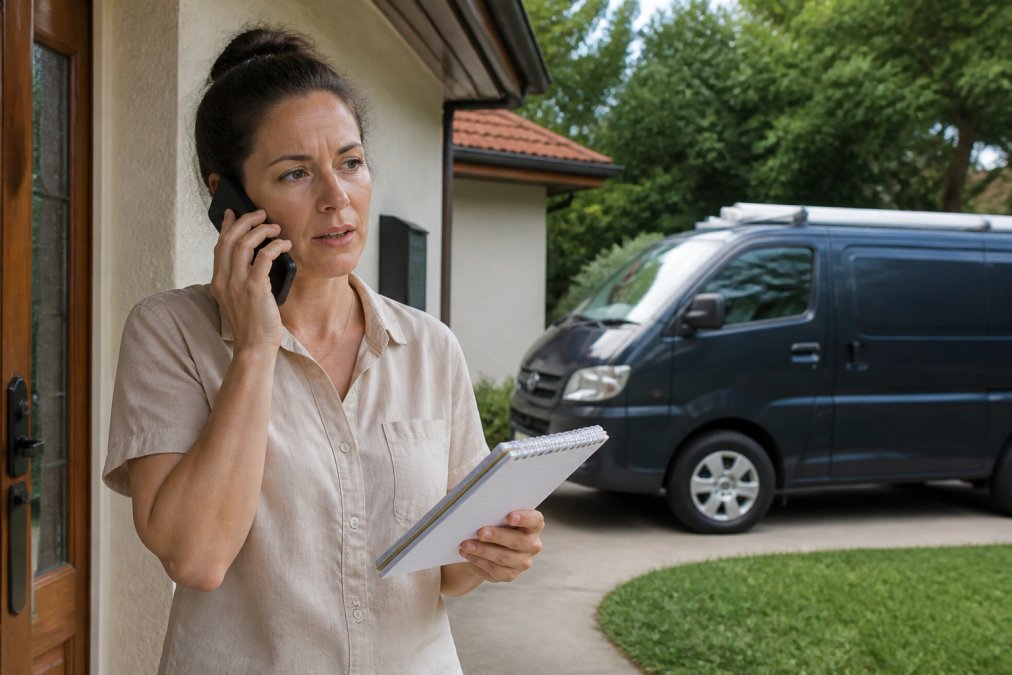
Ask for the total cost structure, not a headline number. A legitimate provider explains the service call fee, labour rate, and parts markup separately, then confirms a fixed-price quote before dispatch. Get the technician’s name and licence details on the phone.
To avoid price gouging, use a script that forces the dispatcher to commit to numbers and credentials before you agree to anything:
“What is your full business name and Australian Business Number (ABN)?”, A legitimate operator provides this without hesitation, and you can verify the ABN free on the Australian Business Register (ABR). Dodging, or claiming a franchise cannot share it, is a major red flag.
“Are you licensed in my state or territory?”, Requirements vary: in New South Wales, locksmiths must hold a security licence issued by the NSW Police Force under the Security Industry Act 1997; in Victoria, a private security business licence from the Victorian Business Licensing Authority. Ask for the licence number and issuing authority; a genuine provider knows this instantly.
“What is your call-out fee, and does it include the first 30 minutes of labour?”, Predatory operators advertise a low call-out fee but charge labour from the moment they leave the depot, not from arrival. Clarify whether travel time is billed and whether the fee is credited toward the total.
“Can you give me a fixed-price quote for a standard lockout, and will you honour it if the lock is a common type?”, For a simple residential lockout (e.g., a standard deadlock or knob lock), a fair provider can often quote a fixed range. Refusing any figure until arrival keeps the door open for inflation.
“Will you provide a written estimate by text or email before you dispatch a technician?”, Non-negotiable. A written estimate creates a paper trail and leverage if the final bill exceeds the quote. If they refuse, hang up.
“What is your after-hours surcharge, and is it a flat fee or hourly?”, After-hours surcharges for locksmith services typically range from $50 to $150, according to Mr. Locks’ 2026 pricing guidance, applied outside standard hours and on weekends or holidays. Ask directly whether the surcharge is flat or hourly, and whether it stacks with the call-out fee. The answer should be immediate and specific.
“What is the name of the technician who will attend, and can I see their identification on arrival?”, A legitimate business provides the technician’s name and confirms they carry photo ID and a licence card. If the person on the phone cannot say who is coming, you are likely dealing with a dispatch centre subcontracting to unknown operators.
“Do you accept card payment, and will I receive an itemised invoice before payment?”, Predatory operators often demand cash and refuse a detailed invoice. A fair provider accepts card (or at least offers a receipt) and itemises every charge.
Written Estimate and Fixed-Price Quote Requests
Request a written estimate by text or email before the technician leaves the depot. A fixed-price quote removes room for on-site inflation and gives you something concrete to hold the provider to. If a business refuses to put anything in writing, treat that refusal as your answer.
Service Call Fee and After-Hours Surcharge Questions
After-hours surcharges for locksmith services typically range from $50 to $150, according to Mr. Locks’ 2026 pricing guidance, applied outside standard hours and on weekends or holidays. Ask directly whether the surcharge is flat or hourly, and whether it stacks with the call-out fee. The answer should be immediate and specific.
A dispatcher who cannot tell you the call-out fee, the labour rate, and the surcharge in one phone call is almost certainly hiding the real cost until you are committed. Hang up and call someone else.
Average Locksmith Call-Out Fee Australia: What to Expect
A fair call-out fee covers travel, the technician’s time, and basic tools for damage-free entry. It should never be quoted as a total job price. The honest figure sits well above the bait pricing in sponsored search results, and that gap is the point.
The table below shows what separates a fair quote from a predatory one:
| What You Are Quoted | Fair Provider | Predatory Operator |
|---|---|---|
| Total price before inspection | Refuses to guess | Quotes $15-$40 |
| Written estimate | Provided upfront | Never offered |
| Call-out fee | Stated clearly | Hidden until arrival |
| After-hours surcharge | Flat rate, disclosed | Inflated on the night |
| Invoice transparency | Itemised | Lump sum, cash preferred |
Pricing depends on the lock type, time of day, and access required. Check a provider’s website or request a quote rather than trusting a number shouted down the phone.
Emergency Locksmith Response Time Expectations
A realistic response window for a genuine local provider is 30 to 60 minutes in most suburban areas. Confirm response time at booking, with a name and estimated arrival window, not a vague “someone will be there soon.”
Response time and price are linked. Dispatch centres that subcontract to whoever is closest cannot guarantee either; a local business with its own technicians can commit to both. If the person on the phone cannot tell you who is coming and roughly when, the job is already off the rails.
Digital Verification Tools and Local Business Checks
Verification takes under two minutes and is the best defence against predatory pricing: cross-check the claimed address against street-level imagery and independent reviews before committing to a call-out. Here is a practical, real-time toolkit for use while locked out, with specific Australian resources and physical identification markers that separate a legitimate operator from a scam.
Here is the quick check we recommend to anyone locked out:
- Search the business name and confirm a street address, not a virtual office
- Open Google Street View and confirm the premises actually exists
- Check for a trade association listing or licence number
- Read recent reviews for mentions of hidden fees or price changes
- Confirm the technician’s identification on arrival before any work begins
Australian Licensing and Verification Databases
Australia has a patchwork of state and territory licensing with no single national register, so you need to know which authority to check. Here are the key ones:
- New South Wales: Locksmiths must hold a security licence under the Security Industry Act 1997, issued by the NSW Police Force. You can verify a licence number on the NSW Police Force website.
- Victoria: Locksmiths require a private security business licence from the Victorian Business Licensing Authority (BLA). Check the BLA’s public register online.
- Queensland: Locksmiths are licensed under the Security Providers Act 1993, administered by the Queensland Police Service. Use their online licence check.
- Western Australia: Locksmiths need a security agent licence from the WA Police Force. Verification is available through their licensing portal.
- South Australia: Locksmiths are licensed under the Security and Investigation Industry Act 1995, regulated by Consumer and Business Services SA.
- Tasmania: Locksmiths require a security licence from Consumer, Building and Occupational Services Tasmania.
- Australian Capital Territory: Locksmiths need a security licence from Access Canberra.
- Northern Territory: Locksmiths are licensed under the Private Security Act 1995, administered by the NT Police Force.
If a locksmith cannot tell you which regulator issues their licence, or if their licence number does not match the public register, do not proceed. This is the single most reliable check you can perform.
Physical Identification Markers: What a Legitimate Locksmith Looks Like
Digital checks are essential, but when the technician arrives you need to know what to look for. Scam operators rely on generic vehicles and uniforms to appear legitimate. Here is how to tell the difference:
A legitimate locksmith will typically have:
- A branded service vehicle with the business name, logo, and often a licence number displayed on the side.
- A uniform or at least a collared shirt with the company name.
- A photo ID and a licence card that they can show on request.
- A professional tool kit, including lock picks, tension wrenches, and a variety of replacement locks.
- An itemised invoice pad or a mobile payment terminal.
A scam operator may have:
- An unmarked vehicle, or a vehicle with a generic magnetic sign that can be removed.
- No uniform, or a plain shirt with no branding.
- No identification, or an ID that looks homemade.
- Minimal tools, often just a drill and a hammer (which they may use to damage your lock and charge for replacement).
- A demand for cash and no receipt.
Consumers are increasingly using tools like Google Street View to verify that a locksmith has a genuine physical presence, as covered in this 2024 guide on avoiding predatory locksmiths. Physical identification markers matter too: a branded service vehicle, a uniform, and a licence card shown on request are all things a fraudulent operator cannot easily fake.
Save a trusted locksmith’s number in your phone before you ever need it. The MLA’s 2026 guidance notes that planning ahead is the most effective way to avoid a scam, because you are never choosing a provider under pressure at 11pm.
Real-Time Verification While Locked Out
If you are locked out right now, here is a 60-second verification sequence for your phone:
- Google the business name + “licence” + your state. If nothing comes up, that is a red flag.
- Check the ABN on the Australian Business Register. A legitimate business will have an active ABN.
- Search the business name on Google Maps and check the street view. Does the address look like a real business premises?
- Look for recent reviews that mention the final price. If multiple reviews mention being overcharged, walk away.
- When the technician arrives, ask to see their licence card before they start work. A legitimate locksmith will show it without hesitation. If they refuse, do not let them touch your lock.
Most guides tell you to be careful but never give you the specific Australian databases, physical markers, or real-time steps to verify legitimacy while standing on your doorstep. Use these tools, and you shift the power back to your side of the door.
What to Do If You Are Being Overcharged
Stop the work and refuse to pay the inflated amount on the spot. Ask for an itemised invoice before payment, photograph the technician, vehicle, and invoice, and note the time and quoted figure. Then dispute the charge with your bank and report the business to your state consumer protection regulator.
Post-incident legal recourse exists, but it depends on evidence you collect in the moment. In some jurisdictions, price-gouging rules cap increases on essential services after a declared emergency, as documented by the California Department of Justice. Local consumer law protections vary, so keep every record and act quickly.
A locksmith should never hold your keys, your door, or your safety hostage to a price you did not agree to. If they do, that is not a pricing dispute. It is fraud, and it should be reported as such.
Frequently Asked Questions
Are dodgy locksmiths overcharging?
Yes, predatory locksmiths frequently overcharge by advertising low bait prices between $15 and $40, then inflating the final bill once you are locked out. Some reported instances show costs reaching $350 to $400, far above the $45 to $70 legitimate emergency range. After-hours surcharges of $50 to $150 are standard, but these should be disclosed upfront. To avoid locksmith price gouging, always request a written estimate and confirm the total before work begins.
How can I verify if a locksmith is legitimate?
Check for a genuine physical address using Google Street View, and look for membership in a professional trade association. Ask for their licence number and verify it with the relevant state authority. A legitimate locksmith will provide a fixed-price quote, a written estimate, and professional identification on arrival. They should also have a marked service vehicle. If they cannot confirm these details, treat it as a red flag and call someone else.
What is the average call-out fee for a locksmith?
Legitimate emergency lockout services typically charge $45 to $70, though this varies by location and time. After-hours surcharges for services outside 7am to 10pm, weekends, or holidays range from $50 to $150. When you ask about the average locksmith call-out fee in Australia, always request a breakdown of the service call fee, labour costs, and any parts markup. A trustworthy provider will give you a fixed-price quote before dispatch.
What are the signs of a locksmith scam?
Key warning signs include unusually low advertised prices, no local business listing, refusal to provide a written estimate, and pressure to pay cash only. Predatory locksmiths often use sponsored search results and fake addresses to appear legitimate. They may also arrive without professional identification or a marked service vehicle. If the price suddenly increases on-site or they claim damage that requires expensive drilling, stop and ask for an itemised invoice. Report fraudulent activity to consumer protection authorities.
Being locked out is stressful enough without wondering whether the person at your door is about to double the price. Morayfield Locksmiths has served the region since 1994 as a family-owned business built on honest upfront pricing, 24-hour availability, and rapid response times, with comprehensive services for homes, cars, and businesses. Get started with Morayfield Locksmiths and know the price before we arrive.