Table of Contents
- Start With a Commercial Property Security Checklist
- How to Secure Commercial Property Through Risk Assessment
- Commercial Lock Upgrades That Actually Deter Break-Ins
- CCTV Installation Requirements for Commercial Premises
- Securing the Investment: Leases, Insurance and Exit Planning
- How to Secure Commercial Property Without Disrupting Tenants
- Frequently Asked Questions
Last Updated: September 22, 2026
Start With a Commercial Property Security Checklist
A commercial property security checklist is a documented audit testing every physical, operational and legal layer protecting a building and its income. Most owners over-invest in cameras and under-invest in doors. The 2026 checklist splits into two passes, and you need both.
Physical Security Audit Essentials
Walk the perimeter first, in daylight and again after dark, checking gate hinges, fence lines, loading docks and blind spots. Then work inward: door frames, strike plates, cylinder quality, window locks, roller shutters, lighting and alarm sensors. Rate every entry point honestly, a weak rear fire door undoes a strong front entrance.
Operational and Legal Checks
Physical hardware is half the job; the other half is paperwork and habit: who holds keys, how they are issued and returned, whether after-hours access is logged, and whether your insurance policy matches how the building is used. Confirm lease obligations around maintenance and make-good, and keep a current asset register of locks, cameras and alarms.
How to Secure Commercial Property Through Risk Assessment
Risk assessment tells you where to spend: identify assets, identify threats, rate likelihood and impact, then treat the highest scores first. A retail unit with cash on site faces a different threat profile from a warehouse holding stock but no cash. Both need perimeter security; only one needs a safe and cash-handling procedure.
Scoring Threats With a Defensible Method
Score each risk 1 to 5 for likelihood and 1 to 5 for impact, multiply the two, and rank. Anything scoring 15 or above gets fixed this quarter; anything under 6 goes on a watch list. This keeps decisions defensible and stops you buying whatever the last break-in scared you into.
Threat Profiles by Asset Type
A single scoring template applied across a mixed portfolio will mislead you. The threat profile changes with the asset:
- Retail and hospitality: cash on premises, late-night trading, high foot traffic, and staff who may be alone at close. Cash-handling procedures, time-delay safes and duress alarms matter more than perimeter fencing.
- Warehouse and logistics: loading dock exposure, after-hours vehicle movement, and high-value stock that is easy to move. Gate control, yard lighting, CCTV with number plate capture and driver verification are the priority.
- Office and professional services: equipment theft, after-hours access by cleaners and contractors, and data-bearing assets. Access control with audit logs and secure server rooms outrank cameras.
- Medical and allied health: scheduled drugs, patient records, and lone-worker risk. Controlled substance storage, duress systems and privacy-compliant CCTV are the core controls.
Regulatory and Insurance Hooks
Your assessment is not just an internal document. Under work health and safety legislation in each state and territory, a person conducting a business or undertaking must manage risks to workers and others, including security risks such as workplace violence and robbery. WorkSafe regulators publish guidance on cash handling and lone worker safety relevant to retail and hospitality premises.
Insurance assessors and police both respond better to a documented risk assessment than to a receipt for new cameras. Keep the scoring sheet, the date, the framework you used and the actions taken. It becomes evidence that you managed the risk, which matters at claim time.
A risk assessment that has not been reviewed after a change of tenant, a change of use, or an incident is worse than no assessment, it shows you knew about the risk and did nothing. Diarise a review at least annually and after every incident.
Commercial Lock Upgrades That Actually Deter Break-Ins
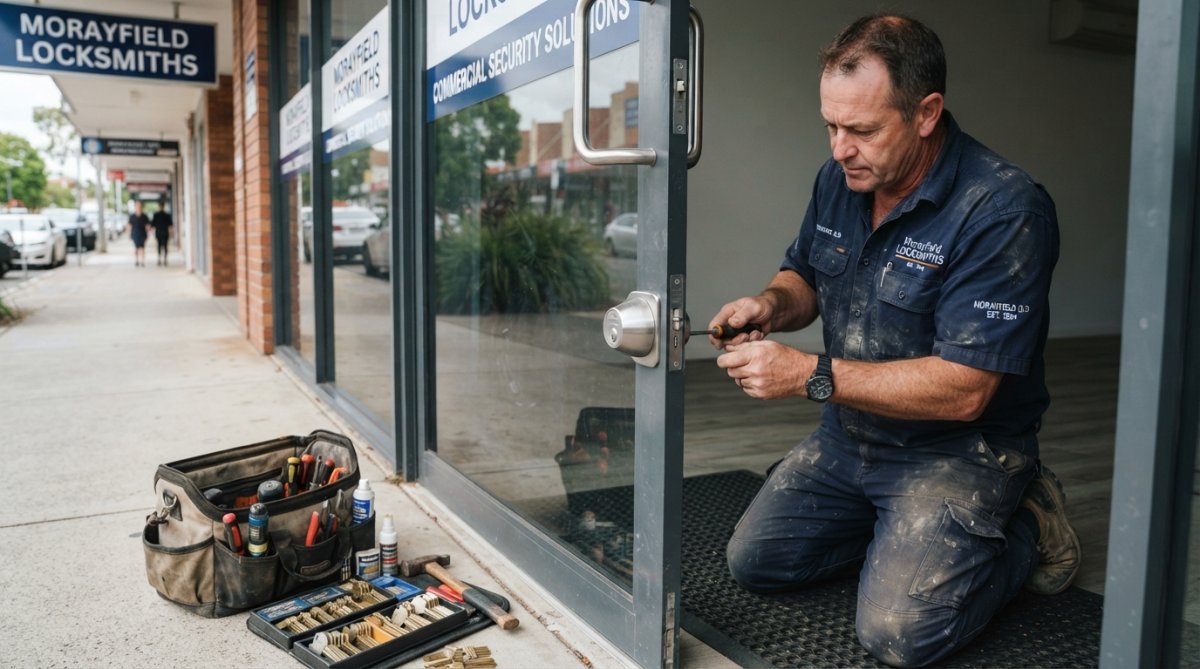
Most break-ins are opportunistic and resolved in under two minutes, so deterrence is about time: make the building slower to enter than the one next door. Commercial lock upgrades that work target the frame as much as the cylinder, because intruders attack the weakest component, not the most expensive one.
Master Key Systems and Restricted Keying
A master key system is a hierarchical keying structure where one key opens multiple doors while individual keys open only their own. Restricted keying means blanks cannot be copied without your authorisation, stopping a departed tenant or contractor from quietly cutting duplicates. For property managers running several sites, this is the single biggest control you can add, and it makes key audits meaningful because you can prove how many keys exist.
Electronic Access Control Integration
Electronic access control replaces “who has a key?” with a log that answers it. Fobs, PIN codes and smartphone credentials can be issued, suspended and revoked in seconds, and every entry is timestamped. For mixed portfolios, older mechanical locks can stay on low-traffic doors while high-traffic and high-value entries move to electronic control, avoiding a full replacement.
The most common failure we see is a new access control system installed without a documented fallback. If the controller loses power or the network drops, staff need a mechanical override that is itself secure. Plan the failure mode before installation, not after.
CCTV Installation Requirements for Commercial Premises
CCTV installation requirements for commercial premises come down to three things: coverage capturing identifiable faces and number plates, retention long enough to be useful, and compliance with privacy obligations. A camera recording a blurry shape at 20 metres is a cost, not a control.
Placement, Coverage and Lighting
Place cameras to capture entry and exit points, cash handling areas, stock storage and any external lane or car park, overlapping fields of view so no approach path is blind. Lighting often matters more than resolution: infrared handles darkness, but glare from a bright sign or streetlight can wash out a face entirely. Test footage at night before signing off.
Storage, Retention and Privacy Obligations
Retention is a balancing act: too short and footage is overwritten before an incident is reported; too long and you hold personal information you do not need. Most commercial sites find a few weeks workable, reviewed against actual incident reporting patterns. Signage notifying people that cameras are operating is standard practice, and footage access should be limited to named staff.
Securing the Investment: Leases, Insurance and Exit Planning
Security is not only about intruders, it is about protecting the asset’s income and resale position. The market rewards owners who can show clean leases, documented compliance and a maintenance history, because buyers and lenders price uncertainty into the deal. Three areas separate a well-secured investment from a vulnerable one: insurance structure, tax treatment, and exit readiness.
Insurance Requirements for Commercial vs Residential
Commercial insurance differs from residential in ways that catch owners out. Commercial policies expect you to disclose the tenant profile, outgoings structure and any hazardous use on site, and may require specific security measures as a condition of cover, conditions residential policies rarely impose. If you upgrade locks or cameras, tell your insurer in writing; some policies reduce excess or premiums when documented security is in place.
The cover types you need to understand are distinct:
- Building and contents: covers the structure and your own fitout, not the tenant’s stock or equipment. Tenants need their own cover, and your lease should require it.
- Public liability: covers injury or damage to third parties on the premises. Most commercial leases require the tenant to hold a minimum amount, commonly $10 million or $20 million, and to name the landlord as an interested party.
- Loss of rent and business interruption: replaces rental income if the property becomes uninhabitable after an insured event. This is the cover most often under-insured, because owners insure the building but not the income stream.
- Legal liability as landlord: covers claims arising from your obligations under the lease, including maintenance failures that cause tenant loss.
Tax Implications and Depreciation Schedules
This is the angle most guides skip, and where the real money sits over a holding period. Two deductions matter:
- Capital works deductions (Division 43): available on the construction cost of the building and structural improvements, typically at 2.5% per year for commercial buildings constructed after 1987, or 4% for certain earlier industrial buildings. This is a deduction against your taxable income, not a cash refund, but it is substantial over a decade.
- Plant and equipment depreciation (Division 40): covers items such as security systems, air conditioning, lifts, fire systems and fitout. Effective lives are set by the Australian Taxation Office and vary by asset, security and access control systems typically have shorter effective lives than building services, which means faster deductions.
Exit Strategy Planning
Most guides focus on buying; few discuss structuring the asset for a profitable sale, yet the decisions you make at purchase determine your exit options.
Environmental Compliance
Environmental obligations sit with the owner, not the tenant, and non-compliance can stall a sale or trigger remediation costs. The main areas are stormwater and trade waste, waste storage and disposal, asbestos registers on older buildings, and energy disclosure for larger commercial assets. State and territory regulators publish guidance on each, and local councils administer many approvals.
The three documents that protect your exit are a current lease, a compliance folder, and a depreciation schedule. If you cannot produce all three on request, you are carrying a discount a buyer will price in.
How to Secure Commercial Property Without Disrupting Tenants
Tenant disruption is why good security plans get abandoned halfway. The fix is sequencing: group works by door and by trade so a locksmith, an electrician and a camera installer are not tripping over each other across three visits. Where possible, schedule access control and lock changes during quiet trading periods, and give tenants written notice with a clear window.
| Stage | What Happens | Typical Frequency |
|---|---|---|
| Risk assessment | Score threats, rank by likelihood x impact | Annually or after any incident |
| Physical audit | Test doors, frames, cylinders, lighting, alarms | Every 6 months |
| Key and access review | Reconcile keys issued, revoke stale credentials | Every 6 months |
| Insurance and lease check | Confirm cover matches use, review obligations | Annually at renewal |
| Compliance review | Environmental, asbestos, waste, energy | Annually |
Frequently Asked Questions
What are the essential security upgrades for a new commercial lease?
Before signing a commercial lease, check what the lease allows you to change. Essential upgrades usually include rekeying or replacing locks, installing a monitored alarm, adding exterior lighting, and setting up access control for staff entries. If the property has an existing CCTV system, test whether it still records usable footage. Document the condition of all security hardware at handover so you are not charged for pre-existing faults at the end of the tenancy.
What is the difference between physical and electronic security for commercial premises?
Physical security covers locks, deadbolts, reinforced doors, grilles, bollards and perimeter fencing. Electronic security covers alarm systems, CCTV, intercoms, keypad or fob access, and smart monitoring. Most commercial properties need both. A strong lock is useless if staff prop the door open, and a camera is useless if the door has a flimsy frame. Layer them so each system covers the weaknesses of the other, and review the setup after any change in tenancy or staffing.
How can I reduce insurance premiums through better commercial property security?
Insurers assess risk based on how easy a property is to break into and how quickly a loss would be detected. Documented measures that often help include monitored alarm systems, certified locks, CCTV with retained footage, exterior lighting, and clear maintenance records. Ask your broker which specific measures your policy recognises before you spend money. Keep certificates and installation records on file, because a claim can be reduced if you cannot prove the security you told the insurer about was actually in place.
How do I ensure my commercial property complies with Australian safety standards?
Compliance depends on your state, the building class and how the premises are used. In Queensland, work health and safety duties sit with the person conducting the business or undertaking, and fire safety, electrical and egress requirements are enforced through local council and building certification processes. Engage a licensed tradesperson for lock, alarm and CCTV work, keep records of every installation, and schedule regular inspections. A single missed maintenance item can void cover or trigger a fine after an incident.
What are the legal responsibilities of a tenant regarding property security?
Under most commercial leases, the tenant is responsible for day-to-day security of the premises, including locking up, reporting damage, and not altering the fit-out without consent. The landlord typically retains responsibility for the building structure, common areas and any base-building systems. Check your lease for clauses on keys, alarm codes, after-hours access and who pays for repairs. Get written approval before installing new locks or cameras, and return all keys and access devices at the end of the term.
How do I know a CCTV system will actually capture useful footage?
Useful footage depends on camera placement, resolution, lighting and retention, not on the number of cameras. Position cameras to cover entry points, cash handling areas, stockrooms and loading docks, and make sure faces and number plates are identifiable at the distance they will be recorded. Test playback after installation, check night-time performance, and confirm how many days of footage are stored. A system that records for 30 days at the right angle beats one that records for 90 days at the wrong one.