Table of Contents
- Why Car Lockouts Still Happen in 2026
- Step 1: Build a Keys-Check Exit Routine
- Step 2: Use Digital Keys and Mobile Apps
- Step 3: Smart Key Fob Maintenance and Anti-Lockout Features
- Step 4: Understand Emergency Car Lockout Services
- Step 5: Know the Cost of Emergency Locksmith Services in 2026
- Step 6: Insurance and Roadside Assistance Coverage
- Common Mistakes to Avoid When Preventing Car Lockouts
- Frequently Asked Questions
Last Updated: September 25, 2026
Why Car Lockouts Still Happen in 2026
Preventing car lockouts in 2026 starts with understanding why they still happen despite smarter cars. Modern vehicles now include factory systems that detect a key fob left inside the cabin and stop the doors from locking, but drivers still get locked out every week.
This guide from Morayfield Locksmiths covers the habits and tools that actually stop lockouts before they happen. We have helped local drivers since 1994.
Here is the thing most guides get wrong: they blame bad luck. In reality, lockouts are a routine problem, not a random event. And a routine problem has a routine fix.
The Psychology of ‘Absent-Minded’ Lockouts
Lockouts rarely happen because someone is careless. They happen because the brain runs on autopilot during familiar tasks.
You drive the same route, park in the same spot, and reach for the door without thinking. When you are stressed, tired, or distracted, that autopilot skips a step. The keys stay on the seat.
The fix is not “try harder.” It is building a physical routine that works even when your mind is elsewhere. That is what the next six steps deliver.
Step 1: Build a Keys-Check Exit Routine
A keys-check exit routine is a fixed sequence you run every time you leave the car. The exact steps matter less than doing them the same way, every single time.
Try this order:
- Turn off the engine and take the key or fob in your hand
- Put the key in the same pocket or bag, every trip
- Touch the pocket to confirm the key is there
- Lock the car while the key is still in your hand
- Look back at the driver’s seat before you walk away
The last step takes two seconds. It catches the one time in a hundred when the routine slips.
Physical Key Management: Lanyards and Carabiners
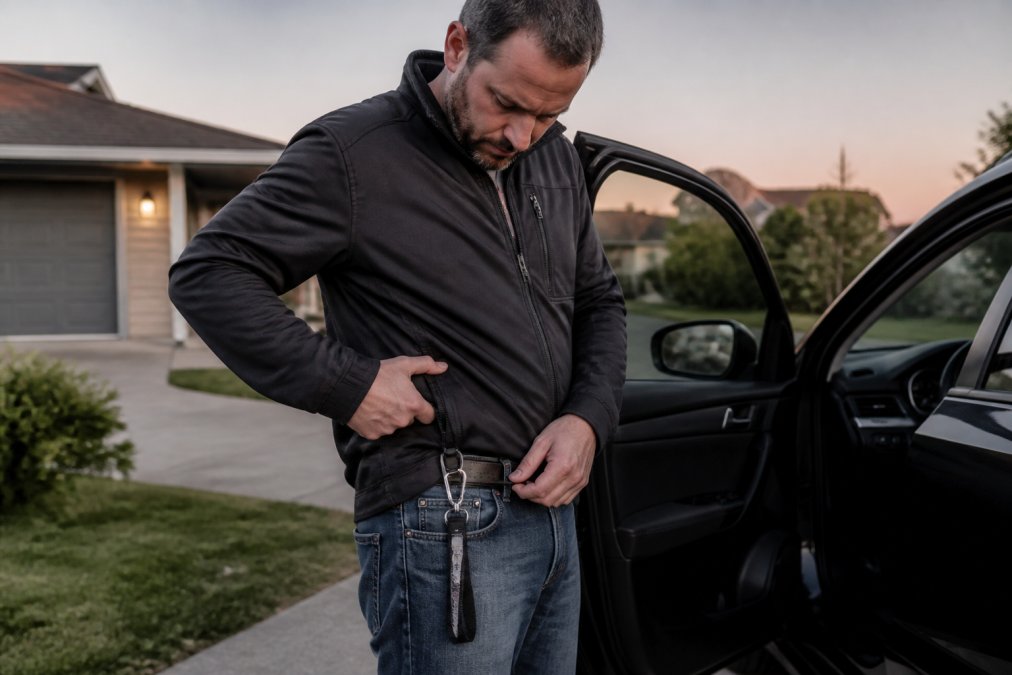
Attaching your key to a lanyard or carabiner gives it a fixed home. A key that lives on your belt loop or bag strap is far harder to leave behind than a loose fob in a cup holder.
Many drivers also keep a magnetic key holder hidden under the chassis for emergencies. It is a useful backup, but check it monthly. Magnets weaken, and dirt can work them loose.
Clip your car key to your house keys on one carabiner. If you ever lock the car key inside, your house key is still with you, and a spare car key at home is one phone call away.
Step 2: Use Digital Keys and Mobile Apps
Digital keys and remote unlock apps are now a primary recovery method for lockout situations, according to Express Locksmith LA’s 2026 lockout guidance. Setting one up before you need it takes minutes.
Most new vehicles let you:
- Create a digital key profile on your phone
- Unlock the doors remotely through the maker’s app
- Start the car without a physical fob
- Share temporary access with family members
The catch is battery and signal. A flat phone or a dead zone leaves you with nothing. Treat the app as a backup, not your only plan.
Smart Home and IoT Integration for Vehicle Access
Smart home systems now link to vehicle access in ways that did not exist a few years ago. A smart garage door can open when your car approaches, and some home hubs log every time a vehicle key is used.
For households with several drivers, this integration solves a common problem. You can see who took which car and when, without a group chat.
The practical warning: every smart system needs a manual override. If the internet drops or the hub fails, you still need a physical key that works. Test that override twice a year.
Step 3: Smart Key Fob Maintenance and Anti-Lockout Features
Smart key fob maintenance is simple, but skipping it causes real problems. A fob with a weak battery sends a weaker signal, and the car may not detect it at all.
Do this every few months:
- Replace the fob battery before it dies, not after
- Keep the fob away from water, heat, and heavy keys
- Store spare fobs in a cool, dry place
- Test each fob’s range from a few metres away
Anti-lockout features are your second line of defence.
Step 4: Understand Emergency Car Lockout Services
Emergency car lockout services exist for the times prevention fails. A professional locksmith opens your car without damaging the seals, glass, or electronic locking system.
What to Do If You Are Locked Out
Stay calm and follow this order:
- Check every door, including the boot and passenger side
- Try your remote unlock app and digital key
- Call a roadside assistance provider if you have cover
- Call a local emergency locksmith with your rego and location ready
- Stay with the vehicle until help arrives
Never leave a child or pet locked in a hot car while you wait. Call emergency services first in that situation.
Step 5: Know the Cost of Emergency Locksmith Services in 2026
The cost of emergency locksmith services depends on the time, the vehicle, and the lock type. There is no single flat rate, and any provider quoting a fixed figure over the phone before seeing the car is guessing.
Expect pricing to vary based on:
- Time of day, with after-hours fees applying at night and on weekends
- Vehicle make and model, since some locks need specialist tools
- Lock type, including keyless ignition and smart entry systems
- Travel distance to your location
- Whether a replacement key is needed
Avoid any locksmith who will not confirm the full price before arriving. A vague quote over the phone often becomes a much larger bill once the job is done.
Step 6: Insurance and Roadside Assistance Coverage
Insurance and roadside assistance coverage can turn a stressful lockout into a free phone call. Many comprehensive car policies and roadside memberships include lockout assistance as a standard benefit. Verifying the specific response times and service limitations of your roadside assistance services ensures you are prepared for the realities of modern vehicle support.
Check your policy for:
- Lockout assistance as a listed benefit
- A call-out limit per year
- Whether after-hours service is covered
- Any excess that applies to a claim
Common Mistakes to Avoid When Preventing Car Lockouts
The biggest mistake is relying on a single method. A digital key with no spare, or a spare with no fob battery, leaves you exposed.
Other common errors:
- Hiding a spare key in the wheel arch or bumper, where thieves check first
- Leaving the fob in the console while loading the boot
- Ignoring a fob that needs a closer press to work
- Letting a child play with the fob near the car
- Assuming the anti-lockout feature covers every door
| Mistake | The Fix | Why It Matters |
|---|---|---|
| Relying on one key method | Carry a spare and set up a digital key | A dead phone or fob leaves you stranded |
| Hiding a key on the car | Give a spare to a trusted person | Thieves check wheel arches first |
| Ignoring a weak fob | Replace the battery early | A weak signal means no detection |
| Skipping the exit check | Run the same routine every trip | Autopilot is what causes lockouts |
Frequently Asked Questions
How can I prevent my car key from being scanned?
Relay attacks use signal amplification to capture your key fob’s signal from inside your home. Store your key fob in a signal-blocking pouch or metal tin when not in use, and keep it away from your front door. Modern vehicles with motion-sensor fobs go to sleep after being stationary, which reduces vulnerability. If your car supports it, disable keyless entry in the settings menu and use the unlock button instead. These steps are part of smart key fob maintenance that costs nothing but protects your vehicle.
Can other people open your car with a keyless remote?
Only if they have a paired fob or can intercept the signal through a relay attack. Keyless entry systems use rolling codes that change with every press, so a simple copy of the signal won’t work. However, thieves using signal amplification devices can boost the fob’s signal from inside your house to the car. Storing your fob in a Faraday pouch blocks this. For older vehicles without rolling codes, aftermarket immobilisers add a layer of protection.
What should I do if I am locked out of my car in 2026?
Stay calm and check all doors, including the boot, in case one is unlocked. If you have a digital key profile or remote unlock app, use it. Call a professional emergency car lockout service rather than attempting to force the door, as modern electronic locking systems are complex and damage can be expensive. In the Moreton Bay region, Morayfield Locksmiths offers 24-hour assistance. Have your identification and proof of ownership ready for the locksmith.
How do people even lock their keys in their car?
Most lockouts happen when the key fob is left inside while the driver exits to do something quick, like check the mailbox or load the boot. The car may auto-lock after a set period, or a passenger may accidentally press the lock button. Modern vehicles with built-in lockout prevention detect the fob inside and refuse to lock, but older models lack this. Building a keys-check exit routine, where you physically touch the fob before closing the door, prevents this.
Preventing car lockouts comes down to routine, backup, and knowing who to call when both fail. Morayfield Locksmiths offers 24-hour emergency lockout assistance, honest upfront pricing, and modern key and fob solutions for drivers across the region. Our team has served the area since 1994, with fast response times and professional, efficient service. Get started with Morayfield Locksmiths and drive away from your next lockout with confidence.